Who's Behind It signal
A foundation: pass or failWhy AI wants to know who's behind the page
Buyers and engines both end up asking the same question about a page: who is behind this? A named person with a real track record answers it. An anonymous page leaves it open. This is the second of the two foundations, and it can be finished.
Who's Behind It
Reading your site…
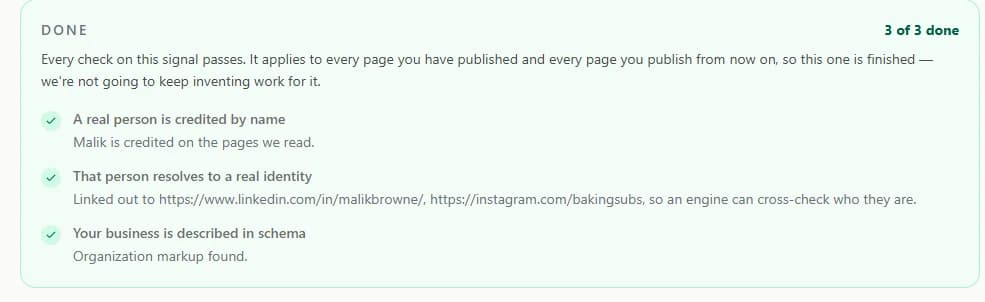
- A real person is credited by name, not "admin" or "the team"
- That person resolves to a real identity: a bio, or links to LinkedIn or a professional profile
- Your business is described in schema: Organization or LocalBusiness markup
- A named method you own, and at least one result with a number, somewhere on the site
Why it matters
What an engine does with it
A real name, a real bio, and links to the other places you show up online make you a recognizable entity rather than anonymous noise. Two facts about your business count here too: whether you've named the way you do the work, and whether there's at least one real result with a number attached anywhere on the site. Being straight about this one: in our own measurements, sites with clean identity markup were not more likely to get cited than sites without it. We keep it on the list because it's finishable in an afternoon, because a human landing on the page asks the same question, and because being unidentifiable is a bad place to be regardless. Not because we can show it moves an engine.
What you'll see
Who's Behind It, in the Tracker
How it's scored
A checklist you can finish
Every site gets a 0 to 10 on this signal. It sits outside your content score as one of the two foundations, and when every check passes it scores 10 and it's done.
Anonymous
0–4"Admin" or "Editorial Team" bylines, no real About page, and no entity an engine could resolve.
Nearly
5–9A named person, but something is open: a thin bio with no profile links, or no business schema. If the site has neither a named method nor a result with a number, it can't go above 7.
Done
10Every check passes. The signal is finished and scores 10.
How to improve it
The changes that move it
In the Tracker
Your Overview shows the identity checks as a checklist read straight off your site. Under Your business you can store an author bio once; the Tracker adds it to any page word for word and never rewrites it, because a paraphrased credential is a liability.
- 1Put a real name on your content, even if the business is just you
- 2Give that name a short bio, or link it to LinkedIn or a professional profile
- 3Add Organization or LocalBusiness schema with your logo and contact details
- 4Name the process you already run, and put one client's result with a number on your About page
If you're a local business
For a local business, the entity an engine has to resolve is the business as a place and the person behind it.
- The owner or practitioner named, with credentials, a bio and a photo
- Your name, address and phone identical everywhere: footer, contact page and schema
- Links to profiles an engine can verify: LinkedIn, professional directories, licensing bodies
- A named way of doing the work, and a number: years in the trade, jobs completed
Questions
Questions, answered
What if I publish under a brand, not a personal name?
The brand counts through its schema, logo and About page, but the checklist asks for a named person too. Put a real name on the content even if the business is just you: a person with a track record is the thing an engine can check.
Does an author photo really matter?
It's part of a bundle. A name, photo, bio, and outbound identity links together tell an engine the author is a real, recognizable person. Any one alone is weaker than the set.
What counts as a named method?
A name for the way you already do the work, rather than a generic process: "our three-visit inspection" rather than "we inspect thoroughly". You almost certainly run one already; naming it is the whole job.
The other five signals
See where you stand on all six.
One scan scores your site on every signal, shows the pages an engine reads and skips, and hands you the fix worth making first.
3-day free trial · then $99/mo, cancel anytime