Topic Focus signal
29% of your content scoreIs your site unmistakably about one thing?
Any given AI answer names a handful of sources, not a long list. Go deep on one subject and you're a plausible candidate for that short shelf. Sprawl across everything and you read as nobody's first choice.
Topic Focus
Reading your site…
- How many pages your site has on each topic, counted from your sitemap
- Whether content is organized into hub-and-spoke clusters or scattered themes
- Whether bylines show real expertise: credentials, named methodologies, first-party data
- Whether the site reads as written by a practitioner or a generalist
Why it matters
What an engine does with it
A site organized into recognizable clusters (a hub page plus supporting pages all covering one subject) reads as a genuine authority. A scatter of unrelated trending posts reads as a generalist. Unlike the two foundations, this one never finishes: there is always more depth to build, so the scan gives it one strategic read rather than a to-do list. Whether that depth converts into more citations is something we're measuring across our own subscribers, and we'll tell you what we find rather than promise it in advance.
What you'll see
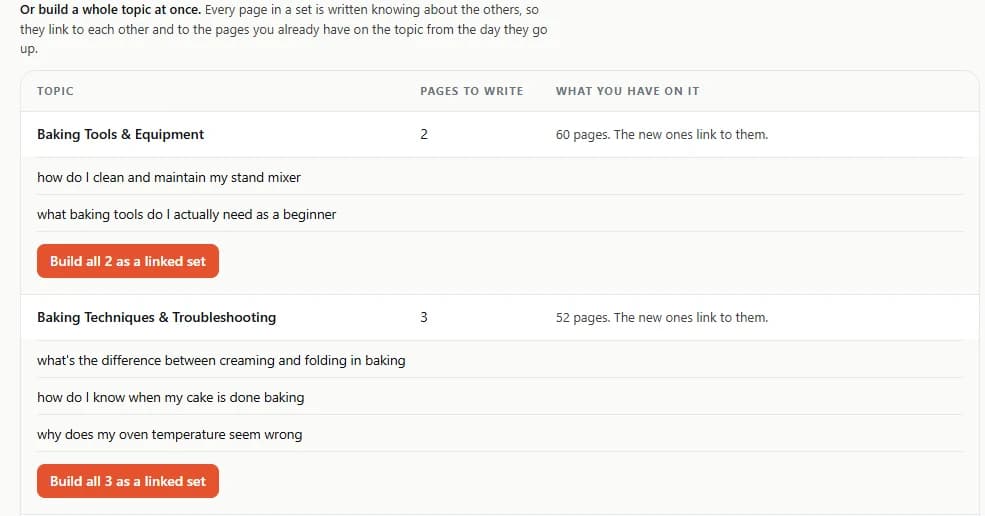
Topic Focus, in the Tracker
How it's scored
A 0 to 10, in three bands
Every site gets a 0 to 10 on this signal, and it makes up 29% of the content score you watch. Here's what each band looks like.
Weak
0–4No clear topical center, generalist 'what's trending' posts, and missing or generic author identity.
Mixed
5–7Some focus, but content is scattered across loosely related themes and the expertise behind it is thin.
Strong
8–10Clearly built around one topic, organized into real clusters, and written by a practitioner. At 8 exactly one thing is short, and the report names it. 10 is rare.
How to improve it
The changes that move it
In the Tracker
The Pages view lists every page you have with the topic it belongs to, and under Write these next, the pages your topics are missing. Any of them drafts in one click.
- 1Pick one core topic and build a cluster of pages around it
- 2Create a hub page that links out to every supporting page on the subject
- 3Fill the gaps in the clusters you already have before starting new ones
- 4Stop publishing off-topic posts that dilute what the site is about
If you're a local business
A local business is judged on its services and the area it serves, not on blog clusters. A missing blog or missing how-to articles is never counted against you.
- A page of its own for each core service you offer
- Each page answers its service fully: what it is, who it's for, what happens, how to book
- The area you serve stated in the page text itself, not only on the contact page
- A homepage and menu that make the whole offer clear at a glance
Questions
Questions, answered
How many pages do I need to look like an authority?
There's no fixed number, it's about depth relative to the topic. A tight cluster of pages that fully covers one subject beats a hundred scattered posts across unrelated themes.
Can a small site build topical authority?
Yes. A focused site that goes deep on one narrow topic often reads as more authoritative than a large, unfocused one. Depth and focus matter more than total page count.
My URLs don't use folders. Does that hurt me?
No. Topics are counted from what your pages are about, not from how your web addresses are structured. A site that publishes everything at the root can be as deep as any other.
The other five signals
See where you stand on all six.
One scan scores your site on every signal, shows the pages an engine reads and skips, and hands you the fix worth making first.
3-day free trial · then $99/mo, cancel anytime