Quotable Content signal
29% of your content scoreHow to write content AI engines will quote
AI engines answer a question by lifting a clean, self-contained passage from a page and attributing it to the source. Pages written as direct answers get pulled into responses. Rambling that buries the point gets skipped.
Quotable Content
Reading your site…
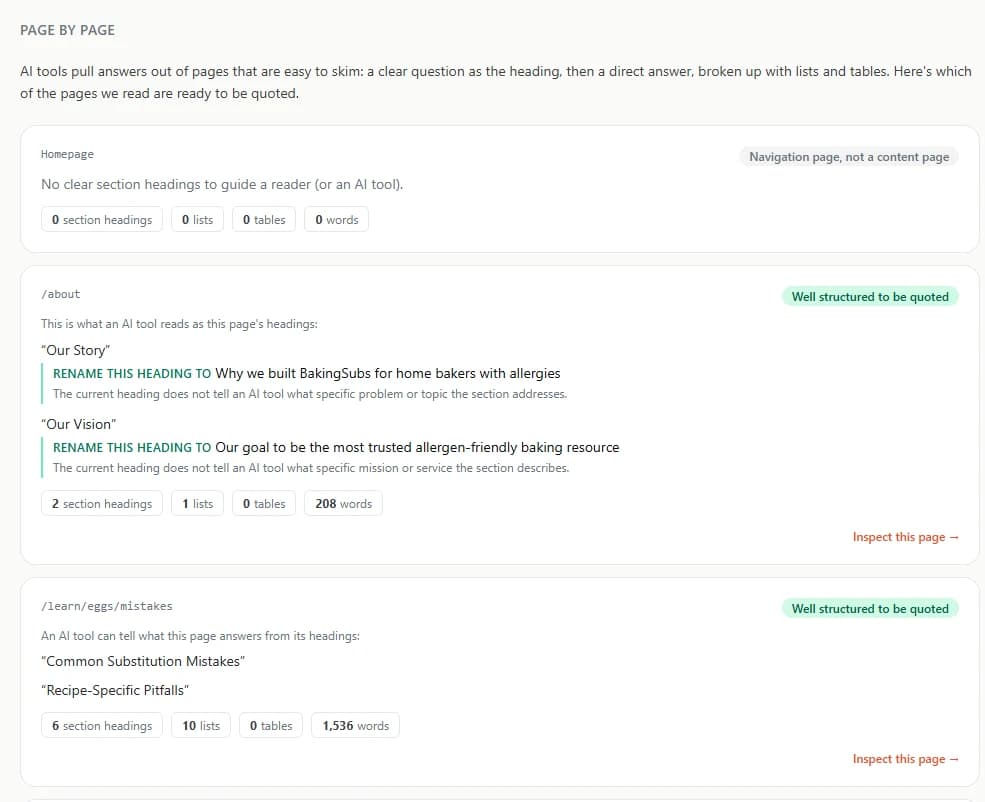
- Whether your H1s and H2s name the real question a buyer would ask
- Whether the answer comes in the first sentence or two, not after a long intro
- Concrete specifics: numbered steps, comparison tables, named amounts, real entities
- Word count and paragraph density: is the page scannable or a wall of text?
Why it matters
What an engine does with it
The same structure that makes a page easy for a human to skim, a clear question, a direct answer up top, specific numbers and named things, is exactly what makes it easy for an AI engine to quote. This isn't about writing for machines. It's about answering the question instead of hiding it under a long intro. When your page states the answer cleanly, an engine can lift it verbatim and credit you. This is also the one signal on this list we have tested against real answers: across the ones we studied, pages carrying a self-contained passage were substantially more likely to be the source an answer actually leaned on. We can't say that yet for the other five, and we would rather tell you which is which.
What you'll see
Quotable Content, in the Tracker
How it's scored
A 0 to 10, in three bands
Every site gets a 0 to 10 on this signal, and it makes up 29% of the content score you watch. Here's what each band looks like.
Weak
0–4Generic listicles and filler-heavy intros, decorative headings, and few specifics a model could pull out.
Mixed
5–7Some pages are tight Q&A; others are loose blog narrative. Headings are descriptive but not question-shaped, and structure is inconsistent.
Strong
9–10Headings name the real question, answers lead the body, and pages are full of concrete steps, tables and specifics an engine can extract cleanly.
How to improve it
The changes that move it
In the Tracker
This is a standard for each page, so the Tracker scores it on the pages it reads but never turns it into an audit of your whole archive. It applies the standard where it counts: every page it drafts opens on a question-shaped heading with the answer in the first lines, and Update page can add key takeaways and an FAQ to a page you already have without rewriting it.
- 1Rewrite headings to match the exact question a buyer would type
- 2Move the answer to the first one or two sentences, then support it
- 3Add concrete specifics: numbered steps, a comparison table, real amounts
- 4Cut the throat-clearing intro that delays the point
If you're a local business
For a local business the questions worth answering are the practical ones a buyer asks before choosing a provider, not editorial topics. The Tracker never asks you for listicles or blog posts here.
- What the service involves and who it's for, stated in the first lines
- What it costs, or a range, and how long it takes
- Insurance or payment where it applies, and how to book
- Question-shaped headings like "How much does a roof inspection cost?" with the answer right under them
Questions
Questions, answered
Isn't writing for AI the same as keyword stuffing?
No. The Tracker rewards ordinary good writing, a clear question answered directly, not content engineered for machines. If anything it marks down pages that read as written for robots instead of readers.
Does long-form content get quoted more?
Length isn't the point, structure is. A short page that answers the question cleanly gets quoted more than a long one that buries it. Density and clarity beat word count.
Do I have to rewrite every page I've already published?
No. This signal is judged page by page, and the Tracker doesn't hand you a backlog of your whole archive. Get new pages right as you write them, and fix the handful of existing pages that matter most.
The other five signals
See where you stand on all six.
One scan scores your site on every signal, shows the pages an engine reads and skips, and hands you the fix worth making first.
3-day free trial · then $99/mo, cancel anytime