Page Connections signal
21% of your content scoreWhat your internal links say about depth
A topic covered by a cluster of linked pages reads as genuine depth, not a one-off post. A page nothing else on your site points at is harder for anyone, human or machine, to arrive at.
Page Connections
Reading your site…
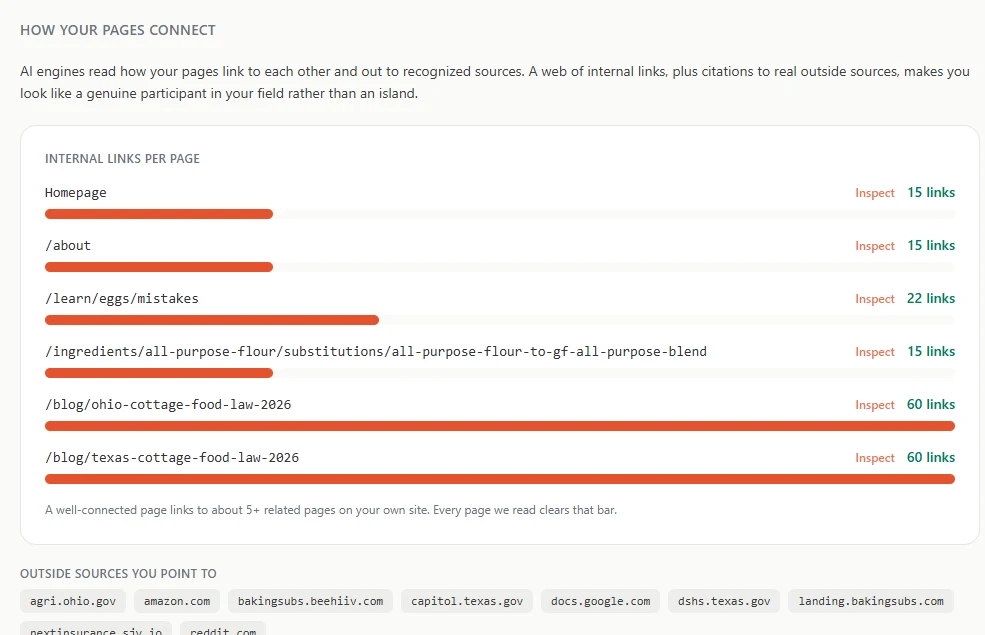
- How many related internal pages each page links to, and the anchor text used
- Whether a hub-and-spoke structure is visible from the homepage
- Outbound links to genuine authorities used as supporting citations
- Pages nothing else on your site links to
Why it matters
What an engine does with it
A web of interlinked related pages, plus links out to recognized sources, reads as a real participant in a subject rather than an island. This is the weakest of the six in our own testing, and the one we're least confident about: we have not been able to show that adding internal links moves whether an engine cites you. It stays on the list because orphaned pages are a real problem for readers and because it's the cheapest thing here to fix, but if you're choosing where to spend an hour, spend it on the page itself first. One thing it never asks: that you link to a competitor.
What you'll see
Page Connections, in the Tracker
How it's scored
A 0 to 10, in three bands
Every site gets a 0 to 10 on this signal, and it makes up 21% of the content score you watch. Here's what each band looks like.
Weak
0–4Pages stand alone, internal links only via the nav menu, and outbound links only to affiliate offers.
Mixed
5–7Some internal links but mostly nav-driven, with few or generic outbound citations.
Strong
8–10Pages link to five or more related pages with descriptive anchors, a hub-and-spoke shape shows from the homepage, and claims cite real authorities. At 8 one side is short, and the report says which.
How to improve it
The changes that move it
In the Tracker
Every page the Tracker drafts is linked into the related pages you already have, so it doesn't land as an orphan. The writer never links a competitor's site, and the score never asks you to either.
- 1Link each page to five or more related internal pages with descriptive anchors
- 2Build a hub page that connects every spoke on a topic
- 3Cite recognized outside sources where a claim needs support
- 4Give every orphaned page at least one link from a related page
If you're a local business
A small site is normal for a local business. The question is whether the pages you have form a connected set, never whether you have a blog network, and density is judged against the number of pages you actually have.
- Every service page reachable from the homepage and the menu
- Service pages linking to related services, the About page and booking in the body text
- Outbound links where claims need support: clinical sources for a health practice, manufacturers or code bodies for a trade
Questions
Questions, answered
How many internal links should a page have?
As a rule of thumb, link to five or more genuinely related internal pages with descriptive anchor text. The goal is a connected web around a topic, not links for their own sake. On a small site, fewer is fine.
Do outbound links to other sites hurt me?
No, citing recognized authorities where a claim needs support is the stronger pattern. The one kind we never recommend is a link to a competitor.
The other five signals
See where you stand on all six.
One scan scores your site on every signal, shows the pages an engine reads and skips, and hands you the fix worth making first.
3-day free trial · then $99/mo, cancel anytime